Thursday, August 11, 2016

The Reading Strategies Book Club: Goal 8

I'm joining up with fellow bloggers again to review the book: The Reading Strategies Book by Jennifer Serravallo!  

Schoolhouse Treasures Reviews The Reading Strategies Book: Goal 8

Thank you to those who have joined me for previous posts in this book study.  If you're new this week, you might want to go back and read the following:

Goal 7 - HERE
Goal 6 - HERE
Goal 5 - HERE
To see with the introduction and the first 4 chapters (which I missed) click {HERE}.  This link brings you to Kelly Malloy's site An Apple For The Teacher


This week we are taking a look at goal 8: 

Determining Main Topics and Ideas (nonfiction)


Schoolhouse Treasures Reviews The Reading Strategies Book: Goal 8 

Why is this goal important?
Students need to know more about the main idea or topic of what they read in nonfiction.  Comprehension of nonfiction text is more than just being able to recall a couple of interesting facts'  This goal is about learning how to understand the entire section of text.  As students progress through to higher reading levels, the text may have multiple main ideas and the need for nonfiction comprehension is critical.

How to tell if your students need to practice this skill:
Jennifer gives several ideas for how to assess students in this skill both formal and informal methods.  You'll know a student needs practice when they can't give you the main idea of the whole text or article; if they give you only a few facts or only give the main idea of a part of the text.

Here's the 1st strategy I've chosen to spotlight this week:


Schoolhouse Treasures Reviews The Reading Strategies Book: Goal 8

8.2 "Notice What Repeats"
Who is it for: Levels A-I
What Genre/Text: Nonfiction
Skills Used: determining importance
  
Students would use this strategy to figure out what a book is mostly about and it involves looking and paying attention to what is repeating on each page.
Jennifer uses a picture from a book about ostriches to show this strategy.  The pictures and text repeatedly uses and shows information about the ostrich's nest.  In the example there are sticky notes with arrows pointing to each section that shows the repetition.  That's a clue that the main idea of this section is ostrich lay eggs in nests that are different from other birds.

Jennifer also briefly explains the different between main topic and main idea.  In early reading levels, (before level J), books have a main topic.  Main idea is more than the main topic.  For example in the above ostrich example: 
Main topic is Ostriches
Main idea is an ostrich has a different kind of nest than most other birds.
NOTE: the author says that for students at the lower levels expecting them to identify main idea may be too difficult; identifying the main topic is sufficient.

Prompt students to notice what repeats - on the page, in text, the pictures.  Have them look for what's the same and use that to state the main idea/topic.

Here's the 2nd strategy I chose:


Schoolhouse Treasures Reviews The Reading Strategies Book: Goal 8

8.2 "Opinion - Reasons - Evidence"
Who is it for: Levels M-Z+
What Genre/Text: Expository nonfiction
Skills Used: determining importance, synthesizing

This strategy involves noticing how the text is organized.  Sometimes the author may come right out and express their opinion and then offers the details 
OR 
the author may start with details and then the author concludes with an opinion.

Paying attention to and following the structure of the evidence, reasons, and opinion will help you to identify the main idea.

I created a poster based on the example shown in the book:


Schoolhouse Treasures Reviews The Reading Strategies Book: Goal 8

Click {HERE} to download the PDF file for this poster.

Finally, the 3rd strategy I chose to talk about today:


Schoolhouse Treasures Reviews The Reading Strategies Book: Goal 8

8.18 "Shrink A Text With a Partner"
Who is it for: Levels M-Z+
What Genre/Text: nonfiction
Skills Used: summarizing, determining importance

This strategy involves reading a section of text with a partner.  Together decide what the main idea is and shrink it down into 1 sentence!

After students have practice doing this with partners several times and are successful, then the author suggests having students work independently.

Steps to this strategy.:
Read a chunk of text.
Stop & decide the main idea with your partner.
Say the main idea in 1 sentence.

I've created a worksheet that I plan to use with my class:
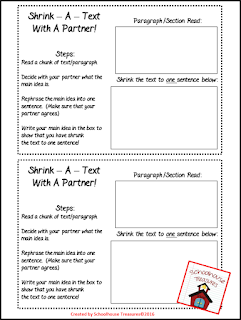


Schoolhouse Treasures Reviews The Reading Strategies Book: Goal 8

Click {HERE} to get a PDF of the worksheet!

I hope you learned something new or got an idea from this post!  I'd love to hear your thoughts or comments below.


There's still time to join us in reading this book!  Get your own copy {HERE}

 photo sig.png

Thursday, August 4, 2016

The Reading Strategies Book: Goal 7

I'm back again (a little late) to discuss the book with some blogger friends! 


You can find my other reviews of goals below:
Goal 6 - HERE
Goal 5 - HERE
To see with the introduction and the first 4 chapters (which I missed) click {HERE}.  This link brings you to Kelly Malloy's site An Apple For The Teacher

Okay - onto this week's goal:


This weeks topic is Goal 7: Understanding Themes and Ideas!


According to the author, Jennifer Serravallo, understanding themes and ideas is important because stories are rich with them and they don't "jump off the page at you".  

Students that need help or extra practice with this strategy are the ones that might give you an answer based on a part of the story, but are not taking the whole story into consideration when identifying the theme.

I had an aha moment when I read this...I know students that are like that.  They give you an answer that's not wrong, but it doesn't encompass everything.  I always say that they are on the edge of the "circle" with their answer but not "dead on" or right in the center.  Now I have some ideas for helping them!  

NOTE: Jennifer does say that students need to have a good understanding of plot, setting, character and vocabulary consistently before working on this skill.

In beginning stories, the theme or lesson is clearly stated in the book but as reading levels progress, they are less and less obvious and are not stated.  

My Thoughts: I've been thinking that this is a skill that may need lots of practice for my 3rd grade students who come from low economic backgrounds.  I also see the connection for the need to  reinforce vocabulary prior to expecting them to do well with theme.

Let's Get Into the 3 Strategies!


7.1 "The Difference Between Plot and Theme"
Who is it for: Levels G-Z+
What Genre/Text: fiction
Skills Used: inferring, determining importance

This strategy involves thinking about whats happening in the plot and then infer the theme by asking what's so important or what's the "big idea" about that.

Jennifer says that students often want to talk about the plot as their theme answer.  She says students will tell you about something that happened and we need to take it a step further and guide them to tell us what is important about that event.

Jennifer writes that "Plot is what happens in the story and theme represents the bigger ideas of the story.  Plot carries the big ideas".  Students have to think beyond the plot to get to the theme.

Get students to stop at important events and take note of the bigger idea/theme/message.

In a whole group lesson, you can model doing this with the class.  An example the author uses is a T-Chart to list the plot events on one side vs. the theme on the other side.

Here's an example of what I came up with for a chart based on what she had in the book, with my own (made up) plot and theme.


Moving on to the next focus strategy.....


Strategy 7.15 - "The Real World in My Book"
Who is it for: Levels N-Z+
What Genre/Text: fiction
Skills Used: inferring, determining importance

Authors will write about real world topics and we can use what we read to think about these topics.  The focus of this strategy is to get students to stop and think about any events in the story that could be a real life event and then take it to another level.  Think about what the author is saying about this topic and then think about the importance of it.

Prompt students to take this time to think about these real world issues by asking:
What real issues are you finding in the story?
What might the author be trying to say?
What ideas do you have?
You've named something that happens in the book, think about how that connects... 

The third and final strategy for this post....


Strategy 7.18 - Character Change Can Reveal Lessons
Who is it for: Levels N-Z+
What Genre/Text: fiction
Skills Used: inferring, determining importance

This strategy involves getting students to think about the character(s) and their traits and how they may have changed from the beginning to the end.  If they think about this change, they'll often get a clue about the lesson, theme or message.

Jennifer's example uses a chart to list the traits of the characters into two columns: At the Beginning / At the End (like a T-Chart) and at the bottom of the chart have the "So...." section.  It's in this section that you would list the possible themes based on the changes listed.

An example that I'm thinking of in my head is the book is Poppy. (I know - I've used this before, but I love the story - so bear with me!)
Traits at the beginning: Poppy is fearful of Ocax; she blindly follows directions and doesn't question things; she doesn't speak up or think for herself

Traits at the end: Poppy is brave, she questions things, she starts thinking and speaking up for herself; she learns that porcupines are not her enemy but actually can be the opposite.

So....: It's okay to question things and think for yourself.
           Face your fears head on!
           Oftentimes, what we are afraid of is not as bad as we         think it is.
            Friends help friends with their problems.
These are all possible lessons/themes/messages from the story.

Well, that's it for this week's goal for me!
I have to say that I am truly enjoying this book!  The number of strategies per goal is amazing.  The strategies are easy to use and implement in a one-to-one conference, a guided reading group and with the whole class.

It's a big book but it's packed with lots of good, useful information!  I think this is one of those books that I will constantly refer to and will effect change in how I teach reading comprehension!  If you don't have it, I'd highly  recommend  that you get a copy!  

{Note - I am not getting anything for saying the above or by giving you a link to purchase below.  I just think the book is so valuable to have!}

Join us in reading this book!  Get your own copy HERE

 photo sig.png

Sunday, July 31, 2016

Best Year Ever!

It's August 1st!!!!
Some of you are already back in school or will be shortly!  
I have till the end of August before school starts.  I have heard so many teachers saying that they think this is going to be a great year!  It's so exciting to hear that and it's no wonder that TPT has decided to use that as the title for the SALE!

Schoolhouse Treasures tips for the BEST EVER SALE

Yes - It's Sale time!  TPT is have a sale August 1-2 and I'm joining with them!  By using the code: BESTYEAR you can save up to 28% off at checkout with purchases from my store!  (20% from Schoolhouse Treasures and then 10% off at checkout = 28% off original cost.)

To get the best out of the sale, here are some tips that I wanted to share:


#1 - Go through your wish list and weed out the things that you put there and forgot about because you really didn't need it ~ OR ~ you have things saved for end of  year or for the holidays!  You don't need them now and you can always search for them when you need it.

#2 - Visit your favorite sellers and click the tab that says "best seller" and change it to "most recent".
Schoolhouse Treasures tips for the BEST EVER SALE

That way you'll be able to see what items your favorite seller has recently added.  You might find something new that you like and need.

#3 - Go to your purchases section.  (You know how to do that, right? If not, here's how you get there: Look to the left of your TPT cart and hover over the "MY TPT" button. Scroll down to purchases.)  Okay, now that you're there, you'll need to see if you've given feedback on all your previous purchases.

How can you tell?  
If you haven't given feedback, you'll see the words "Give Feedback" under the title of the product.  If you did give feedback, you'll see the message, "Thank you for providing feedback on this item.  You rock!"  If you've never left feedback, it can be quite tedious, but worth it to catch up now.  Remember to do it shortly after purchasing something each time - that way you'll keep up with it.

Why is this important?  
Every time you leave feedback on an item, you earn a TPT credit.  Depending on the cost of the item, the amount of credit will vary.  TPT keeps track of your credits and once you have 20 credits, you can apply the credits to a purchase.  20 credits = $1 in savings.  Pretty Cool - isn't it?

When in your cart, you'll see the checkout bar and below that it says apply Promo Code ~ for the sale, you'll type: BESTYEAR and below that, (red arrow) is where you click to see if you have at least 20 credits to use and apply.

Schoolhouse Treasures tips for the BEST EVER SALE

#4 - The day of the sale, make sure that the seller is participating in the sale, and/or that the item you want is for sale.  Not all sellers participate, and some of those that do, only choose some of their items to be on sale.  Also, seller can determine how much of a discount they want to give, so check around to make sure you get your best deal for the sale! 

I hope you found some of the tips helpful!  Let me know in this comments if any of these in particular were helpful to you!  As for me, my TPT store is having 20% off everything! Click {HERE} to go directly to my store!

 photo sig.png

Thursday, July 28, 2016

Reading Strategies Book Study - Goal 6

Last week I joined up with other bloggers to read Jennifer Serravallo's book, The Reading Strategies Book: Your Everything Guide To Developing Skilled Readers

If you are just joining me for the first time in this book discussion, you might want to check out last week's review of Goal 5 {HERE}


Schoolhouse Treasures Reviews Reading Strategies Book - Goal 6: Characters

Goal 6: Thinking About Characters

Understanding characters is an important skill, only second to understanding plot and setting according to Serravallo.

Assessing character understanding would come after you know that the student(s) have an understanding of  plot and setting.  Serravallo suggests that this assessment can be simply asking questions about the character during a reading conference.

Jennifer also suggests that there is a continuum of developmental responses that you might see in their responses.  I've created a chart that outlines the types of responses and the level at which they should respond {HERE}  If a student is reading at a higher leveled book but giving you a lower level answer when discussing characters, then you know that they need more instruction in this goal.


Schoolhouse Treasures' Review of The Reading Strategies Book


The Influences on Character:

Who is it for: reader at N-Z+ Levels
Genre: fiction
The skills used: are determining cause & effect and inferring

Students need to consider all the influences on a character: setting, problems, other characters and what effects it might have on the character earlier or later in a story.

When  you study character in different situations, it will help you to see them from different viewpoints.  We can track these effects on a chart or diagram like the one below: 

Schoolhouse Treasures' Review of The Reading Strategies Book


Focus Strategy 2.jpg

Complex Characters:

Who is it for: reader at N-Z+ Levels
Genre: fiction
The skills used: comparing & contrasting; inferring


This strategy helps students to see characters are complex and not just one way.  In other words, they are like real people with many different sides to them depending on who they are around, the circumstances they face, and the setting.  

One way to do this is to create a T-chart and list the good and bad traits of the character.  Students list the ways that the character is bad and the ways he is a good person.

Click {HERE} to get a sample list of traits from Scholastic!

Another way to do this is to provide students with lists of words for traits and have them list as many as they can that describe the character.   A word wall could be made with these words and referred to throughout the year with different characters.

Creating a web with the character in the middle and then lines going off (similar to above Poppy chart) and on the lines students write the traits, but also gives evidence to show how they are the given trait.

Focus Strategy 3.jpg

A Strategy for Younger Students!
Role-Playing Characters to Understand Them Better

Who is it for: reader at F - N Levels
Genre: fiction
The skills used: inferring, visualizing, and fluency

Jennifer says that role playing helps a student to put themselves in the characters place to better understand them. Let students use puppets, props, or act out the scene with others.  Encourage them to talk and move like the character would.  

Provide these prompts too:
  • How would your character act?
  • Make the puppet talk like the voice of your character.
  • Now that the puppet acted like the character, how do you think they felt? and What kind of person do you think they are?
  • Based on what the character said or did, what are you thinking now? 

That's it for this review!  We are only highlighting a few strategies at each post.

To see with the introduction and the first 4 chapters (which I missed) click {HERE}.  This link brings you to Kelly Malloy's site An Apple For The Teacher

Join us in reading this book!  Get your own copy {HERE}


Sunday, July 24, 2016

Opening My 1st Elementary Box


Do you know about Elementary Box?  I just recently learned about it myself and earlier this month I received my first box for July!

Review of July Elementary Box


It's a monthly subscription much like Stitch Fix, but it's teaching materials - not clothing. It's different in that you don't have choices about what comes other than choosing your grade level.  And...you don't get to send anything back.

The cost is $29 per month.  There are other plans that will save money such as paying for 6 months or a year at a time.  (I didn't want to order multiple months at a time until I had a chance to try it out for a few months.)

It's a box of surprises that that comes once a month during the last week of the month.  The items are geared for the next month. (For example at the end of August, you'll receive a box of items for September.)

Let's take a look into what I got for the first month!


Inside of Elementary Box - July

This is what the box looks like when opened.  It came with a cute postcard on the top that was labeled July 2016.  The card read:  
"Happy Summer!  This month's Elementary Box is all about organization.  Filled with lots of super useful organizational items, you'll be sure to get next school year started out right.  But for now, enjoy your much deserved rest and relaxation."
The back of the card lists all the items with a description, along with their value.

Here's the first few items I pulled out of the box:


colorful dots on nametags, sticky notes and paper

This will definitely help to get me organized for next year!  I love the color scheme!  I am going with a black and neon pick and blue look so this matches perfectly. The sticky notes have a total of 808 sheets!  Yikes - that should last me for a while!  There are 36 name plates - plenty for most class sizes - I hope!   I am planning on using my for labeling items - so 36 is plenty for me. 

 (Not sure what I'd do if it didn't match my scheme - BUT black goes with many colors so if probably would be fine anyways.)

Then these items were next:

Punch cards and labeled clips in Elementary Box for July.

I'm loving the colors!  
The binder clips are large-sized and are labeled with: To Be Graded, Graded, Make Copies, File and Send Home.  I've been wanting these for a while now and was going to try labeling my own, but this is much better than what I could've done!

The punch cards are adorable and can be used for whatever you want to motivate students to do.  I've made some through VistaPrint and love using them.  These will be a nice addition!  I think I will use them to reward homework being turned in on time!

So, that's it for my goodies!  The total value listed is $38 for all of the above.  Overall, I'm pleased with the items and their quality.  I'll continue for a few more months and decide if I want to continue or not.  Maybe  you can help me to decide!
Let me know if you get an Elementary Box shipped to you each month OR if you've had it in the past.  Leave me a comment below!

ALSO...

And don't forget to enter into the giveaway for an Erin Condren Teacher Planner!  I posted about it {HERE}.  The giveaway runs until July 27th.